
Connect • Inspire • Empower

PhD Roadmap

A Roadmap with Two Tracks

There's no single right path through a PhD. Two parallel tracks run side-by-side: the academic milestones set by your program, and the developmental career stages the Career Center helps you build through. This page lays out both so you can pace them together.


Doctoral Program Milestones 

Each UCR doctoral program has its own structure, but most share the same six phases. 

Pick your field to see the focus and key milestone for each phase. Always confirm specifics with your program handbook and your advisor.


Humanities
1
FOUNDATION
Focus
Seminars & language study
Milestone
Identifying “major fields”
2
MASTERY
Focus
Finished coursework & pedagogy
Milestone
TA-ship
3
CANDIDACY
Focus
Comprehensive reading
Milestone
Qualifying exams & prospectus
4
RESEARCH
Focus
Chapter 1, fieldwork, grant writing
Milestone
The “deep research” phase
5
WRITING
Focus
Chapter drafting & fellowships
Milestone
ABD (All But Dissertation)
6+
COMPLETION
Focus
Polishing & job market
Milestone
Defense & graduation
Social Sciences
1
FOUNDATION
Focus
Coursework & methods training
Milestone
Selecting advisor & research area
2
MASTERY
Focus
Specialization seminars & TA teaching
Milestone
Master’s paper / field-area exam
3
CANDIDACY
Focus
Comprehensive exam preparation
Milestone
Comp exams & prospectus
4
RESEARCH
Focus
IRB approval, fieldwork & data collection
Milestone
Data collection complete
5
WRITING
Focus
Chapter drafting & conference papers
Milestone
ABD & first job applications
6+
COMPLETION
Focus
Polishing & job market
Milestone
Defense & graduation
STEM
1
FOUNDATION
Focus
Core coursework & lab rotations
Milestone
Joining a lab / selecting advisor
2
MASTERY
Focus
Advanced coursework & TA-ship
Milestone
Written / qualifying exam
3
CANDIDACY
Focus
Research proposal & committee formation
Milestone
Advancement to candidacy
4
RESEARCH
Focus
Experiments, analysis & conferences
Milestone
First-author paper submitted
5
WRITING
Focus
Dissertation drafting & fellowships
Milestone
ABD & final experiments
6+
COMPLETION
Focus
Defense prep & job market
Milestone
Defense, graduation & transition
Note: These are general timelines representative of UCR doctoral programs. Each program has specific requirements, confirm with your program handbook and advisor.

Download the printable milestone roadmap (PDF), the Humanities graphic is complete; the Social Sciences and STEM graphics use the same six-phase content as above and will be finalized before launch.

Career-Development Stages

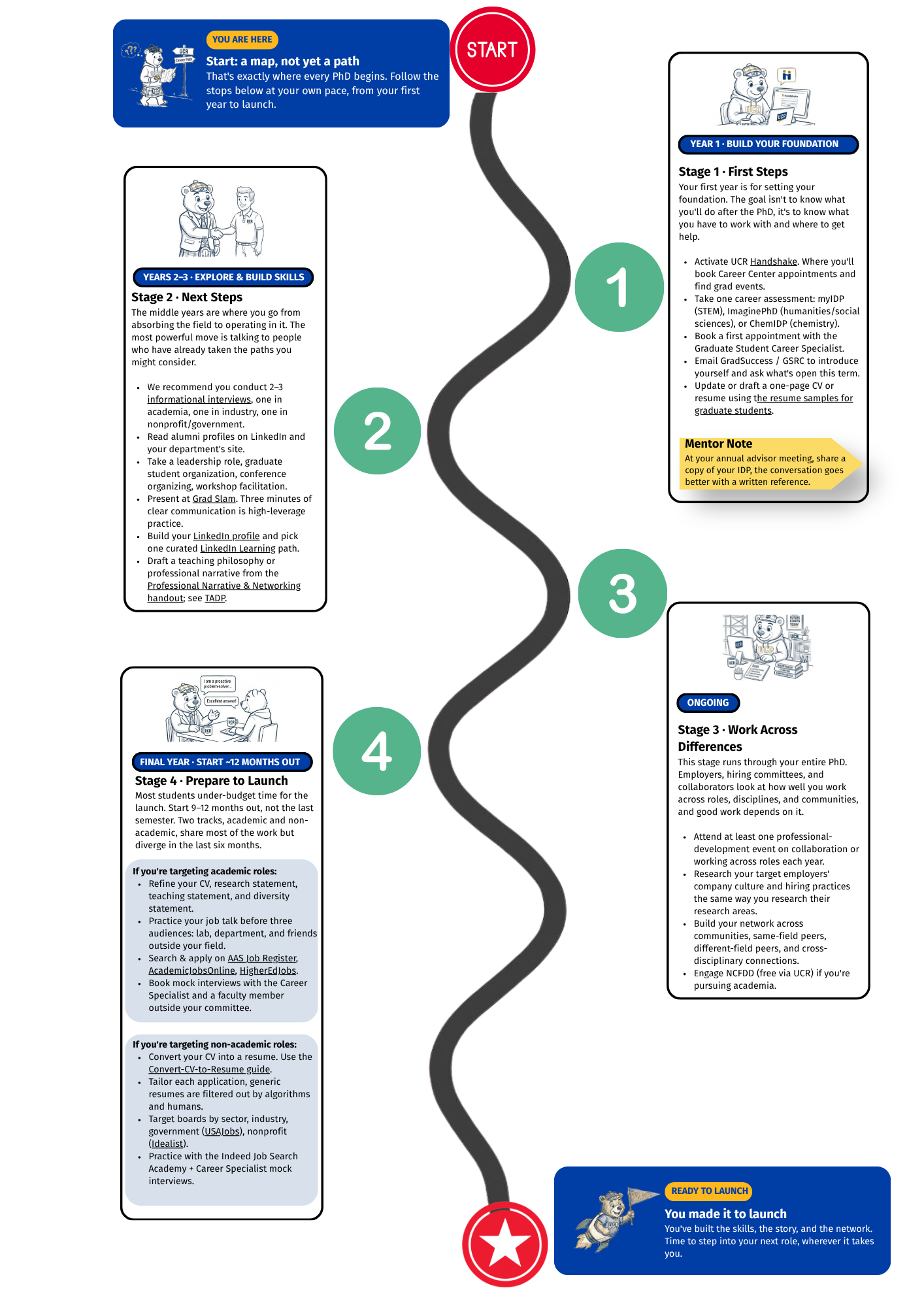
Alongside your academic milestones, the Career Center maps four developmental career stages. The same four stages apply to both PhD and master's students, the actions inside differ.
PhD Roadmap Master's Roadmap 
Year 1 · First Steps
Build Your Foundation

Your first year is for setting your foundation. The goal isn't to know what you'll do after the PhD, it's to know what you have to work with and where to get help.

  • Activate UCR Handshake. Where you'll book Career Center appointments and find grad events.
  • Take one career assessment: myIDP (STEM), ImaginePhD (humanities/social sciences), or ChemIDP (chemistry).
  • Book a first appointment with the Graduate Student Career Specialist.
  • Email GradSuccess / GSRC to introduce yourself and ask what's open this term.
  • Update or draft a one-page CV or resume using the resume samples for graduate students.

Mentor note

At your annual advisor meeting, share a copy of your IDP, the conversation goes better with a written reference.

Years 2-3 · Next Steps
Explore & Build Skills

The middle years are where you go from absorbing the field to operating in it. The most powerful move is talking to people who have already taken the paths you might consider.

Ongoing · Work Across Differences
Build Inclusive Skills

This stage runs through your entire PhD. Employers, hiring committees, and collaborators look at how well you work across roles, disciplines, and communities, and good work depends on it.

  • Attend at least one professional-development event on collaboration or working across roles each year.
  • Research your target employers' company culture and hiring practices the same way you research their research areas.
  • Build your network across communities, same-field peers, different-field peers, and cross-disciplinary connections.
  • Engage NCFDD (free via UCR) if you're pursuing academia.
Final Year · Prepare to Launch
Apply & Transition

Most students under-budget time for the launch. Start 9–12 months out, not the last semester. Two tracks, academic and non-academic, share most of the work but diverge in the last six months.

If you're targeting academic roles
  • Refine your CV, research statement, teaching statement, and diversity statement.
  • Practice your job talk before three audiences: lab, department, and friends outside your field.
  • Search & apply on AAS Job Register, AcademicJobsOnline, HigherEdJobs.
  • Book mock interviews with the Career Specialist and a faculty member outside your committee.
If you're targeting non-academic roles
  • Convert your CV into a resume. Use the GradSuccess Convert-CV-to-Resume guide.
  • Tailor each application, generic resumes are filtered out by algorithms and humans.
  • Target boards by sector, industry, government (USAJobs), nonprofit (Idealist).
  • Practice with the Indeed Job Search Academy + Career Specialist mock interviews.


Talk to someone

Book a 1:1 with the Graduate Student Career Specialist, Dr. Vanessa Lee. Most questions answered in one session.

Book via Handshake

Quick contacts

Grad Career Specialist
Dr. Vanessa Lee · Book via Handshake
GradSuccess / GSRC
Dr. Monique Posadas
GSA Career Liaison
gsacareercenter@ucr.edu
Career Center
(951) 827-3631
You Belong at UCR

All programs, services, and events offered through Student Affairs are open to everyone, consistent with federal and state law and the University of California’s nondiscrimination policies. Whether you’re seeking support, joining a community, or participating in campus life, every effort is made to ensure your experience is inclusive, respectful, and accessible, regardless of background or identity.

To learn more, visit the UC Nondiscrimination Statement or the Nondiscrimination Policy Statement for University of California Publications Regarding Student-Related Matters.

Let us help you with your search